
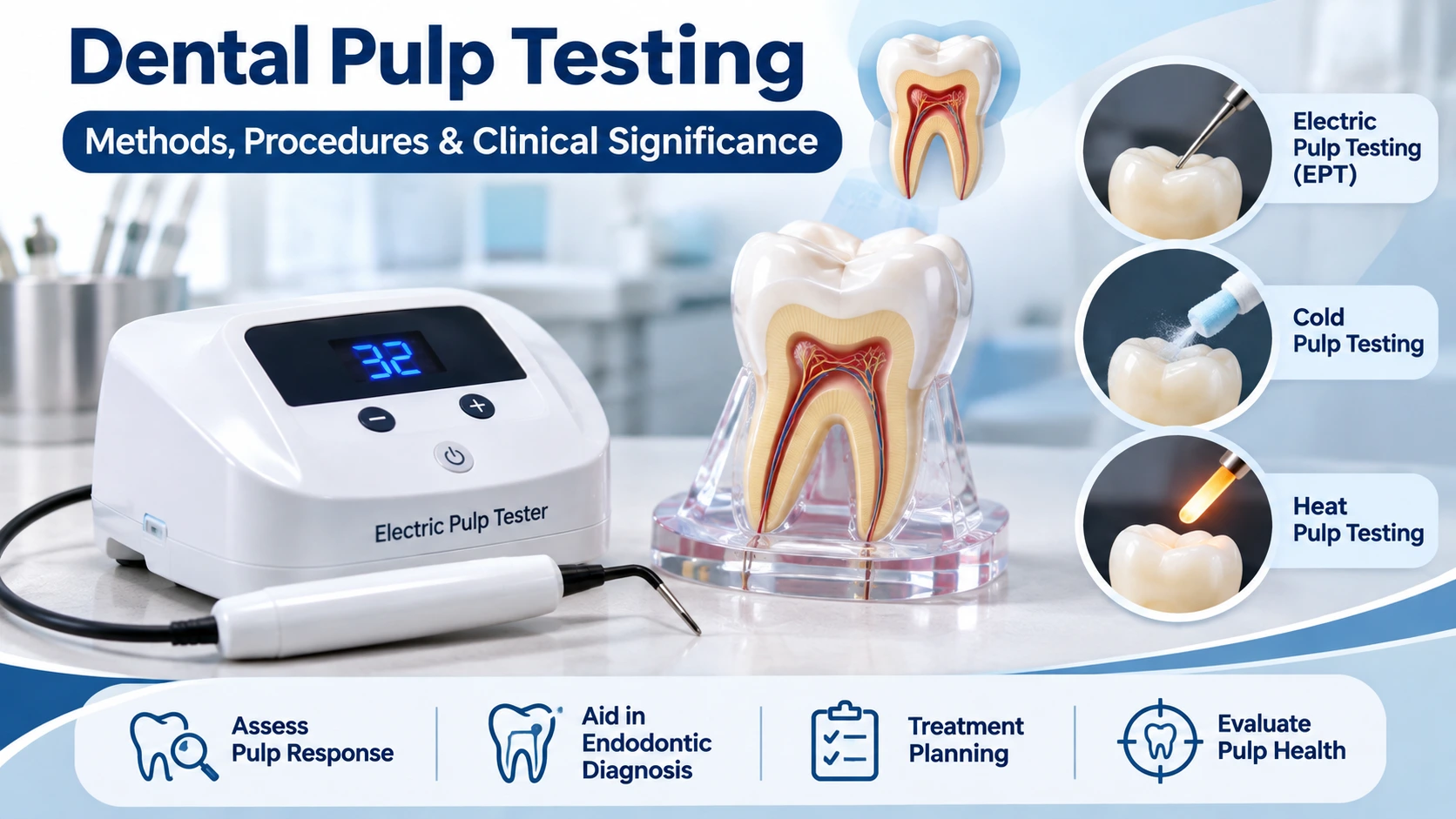
Learn how dental pulp testing works, including electric pulp testing, cold testing and heat testing. Understand pulp vitality, sensibility, diagnostic methods and the role of Parkell pulp testers in endodontics.
Understanding the condition of dental pulp is an important part of endodontic diagnosis. Before deciding whether a tooth requires root canal treatment or another procedure, dentists need to evaluate the condition of the pulp and surrounding tissues.
Dental pulp testing helps clinicians assess how the pulp responds to different stimuli. Common methods include electric pulp testing (EPT), cold testing and heat testing. These methods provide useful diagnostic information when interpreted alongside the patient's symptoms, clinical examination and radiographic findings.
But what exactly is dental pulp testing? How does an electric pulp tester work? What is the difference between pulp vitality and pulp sensibility?
This article explains the major dental pulp testing methods, their clinical applications, limitations and the role of diagnostic devices such as the Parkell Digitest 3.
What Is Dental Pulp?
Dental pulp is the soft connective tissue located inside the pulp chamber and root canals of a tooth.
It contains several important structures, including:
- Blood vessels that supply nutrients and oxygen.
- Sensory nerve fibres responsible for detecting stimuli.
- Connective tissue that supports the pulp.
- Cells involved in dentin formation and repair.
The dental pulp plays an important role in tooth development, nutrition, sensation and defence mechanisms.
When the pulp becomes inflamed or damaged due to deep caries, trauma, cracks or other conditions, its response to different stimuli may change.
This is why pulp assessment is an important part of endodontic diagnosis.
What Is Dental Pulp Testing?
Dental pulp testing refers to diagnostic procedures used to evaluate the response of dental pulp to different stimuli.
These tests help clinicians gather information about the sensory response of the pulp and assess possible pulpal conditions.
The commonly used methods include:
- Electric Pulp Testing (EPT)
- Cold Pulp Testing
- Heat Pulp Testing
An important distinction is that electric and thermal pulp tests are generally called pulp sensibility tests, because they evaluate the response of sensory nerves.
They do not directly measure blood flow within the pulp. True pulp vitality is associated with the presence of a functioning blood supply.
Therefore, a positive or negative pulp test result should not be considered a complete diagnosis on its own.
Pulp Vitality vs Pulp Sensibility: What Is the Difference?
The terms pulp vitality and pulp sensibility are sometimes used interchangeably, but they describe different aspects of pulp assessment.
Pulp Sensibility
Pulp sensibility refers to the ability of sensory nerve fibres within the pulp to respond to a stimulus.
Electric pulp testing and thermal tests are examples of sensibility tests.
They assess whether a patient experiences a response when the tooth is exposed to electrical, cold or heat stimulation.
Pulp Vitality
Pulp vitality refers to the biological health of the pulp, particularly its blood supply.
Methods such as laser Doppler flowmetry and pulse oximetry are designed to evaluate vascular or blood-flow-related characteristics.
Key Differences
| FeaturePulp SensibilityPulp Vitality | ||
| What is assessed? | Neural response | Blood supply |
| Common methods | Electric, cold and heat tests | Laser Doppler flowmetry, pulse oximetry |
| Patient response | Generally required for conventional sensibility tests | Depends on the method |
| Clinical purpose | Helps assess pulp response | Helps assess biological vitality |
| Main limitation | Does not directly measure blood circulation | Some methods have practical and equipment limitations |
Understanding this distinction helps prevent incorrect interpretation of pulp test results.
1. Electric Pulp Testing (EPT)
Electric pulp testing is a commonly used diagnostic method in endodontics.
An electric pulp tester delivers a controlled electrical stimulus to the tooth. The stimulus is gradually increased until the patient indicates that they can feel it.
The response suggests that sensory nerve fibres are responding to the stimulus.
Electric pulp testing is often used as an additional diagnostic method when evaluating the condition of a tooth.
How Does an Electric Pulp Tester Work?
The device delivers a small electrical current through a probe placed on an appropriate tooth surface.
A conductive medium, such as toothpaste, may be used to improve electrical contact between the probe and the tooth.
The electrical stimulus is gradually increased. When the patient first notices a sensation, the clinician stops the test and records the response.
The result is then compared with an appropriate control tooth and interpreted alongside other clinical findings.
General Steps Involved in Electric Pulp Testing
- Explain the procedure to the patient.
- Examine the tooth and identify a suitable testing surface.
- Isolate and dry the tooth as required.
- Apply a suitable conductive medium to the probe.
- Place the probe on an appropriate tooth surface without contacting gingiva or metallic restorations.
- Increase the electrical stimulus according to the device instructions.
- Ask the patient to indicate when they first notice a sensation.
- Stop the stimulus and record the reading.
- Compare the result with a suitable control tooth.
The exact procedure should follow the manufacturer's instructions for the selected device.
What Does an Electric Pulp Test Result Mean?
A response indicates that sensory nerve fibres have responded to the electrical stimulus.
However, a positive response does not automatically establish that the pulp is healthy.
Similarly, an absent response does not always confirm pulp necrosis.
Clinical conditions such as recent trauma, immature root development, extensive restorations and other factors may affect the result.
For this reason, EPT should be used as part of a wider diagnostic assessment.
2. Cold Pulp Testing
Cold testing is another commonly used method for evaluating pulp sensibility.
In this method, a controlled cold stimulus is applied to the tooth, and the patient's response is observed.
Cold testing is widely used in clinical endodontics because it provides information about the sensory response of the pulp to a thermal stimulus.
How Is Cold Pulp Testing Performed?
A cold testing agent is applied to a small cotton pellet or another suitable carrier according to the product instructions.
The pellet is placed against an appropriate tooth surface.
The patient is asked to indicate when they feel a sensation and when the sensation disappears.
The clinician observes the intensity and duration of the response and compares it with control teeth.
What Can Cold Testing Help Identify?
Cold testing may help clinicians assess whether the pulp responds to thermal stimulation.
The nature and duration of the response can contribute to the assessment of pulpal conditions.
However, the findings must be interpreted with symptoms, examination and radiographic evidence.
3. Heat Pulp Testing
Heat testing is another thermal method used to evaluate pulp sensibility.
It may be considered when the patient's symptoms suggest sensitivity to heat or when other diagnostic findings require additional investigation.
A controlled heat stimulus is applied to the tooth using an appropriate clinical method.
The patient's response is observed and recorded.
Heat testing is not required in every case. Its use depends on the clinical presentation and the dentist's diagnostic judgement.
Electric Pulp Testing vs Cold Pulp Testing
Both electric and cold pulp testing are used to assess pulp sensibility, but they work through different types of stimulation.
| ComparisonElectric Pulp TestingCold Pulp Testing | ||
| Stimulus | Electrical current | Cold temperature |
| Main response assessed | Neural response | Neural response |
| Equipment | Electric pulp tester and probe | Suitable cold testing agent and carrier |
| Patient feedback | Indicates when a sensation is first noticed | Reports sensation and its duration |
| Clinical use | Additional assessment of pulp sensibility | Commonly used for pulp sensibility assessment |
| Limitations | False responses and non-responses can occur | Results may be affected by restorations, technique and other factors |
Neither method should be used as the sole basis for deciding whether root canal treatment is necessary.
Using multiple diagnostic findings can provide a more reliable clinical assessment.
When Do Dentists Perform Dental Pulp Testing?
Dental pulp testing may be used in several clinical situations.
1. Deep Dental Caries
Deep caries may affect the pulp and cause inflammation.
Pulp testing can help the clinician evaluate the tooth's response and contribute to treatment planning.
2. Dental Trauma
After an injury, a tooth may temporarily show an altered or absent response to sensibility testing.
A negative result immediately after trauma does not necessarily confirm pulp necrosis.
Follow-up testing may be required.
3. Tooth Discolouration
Discolouration may occur for several reasons, including previous trauma or pulpal changes.
Pulp testing can contribute to the investigation when interpreted with other findings.
4. Cracked or Fractured Teeth
When a tooth has a suspected crack or fracture, pulp testing may help assess its sensory response.
The results should be considered alongside clinical examination and other diagnostic procedures.
5. Monitoring After Dental Treatment
Pulp testing may be used during follow-up after deep restorations, trauma or other dental procedures.
Comparing findings over time can help the clinician evaluate changes in the tooth's response.
Factors That Can Affect Dental Pulp Test Results
Pulp testing results are influenced by several clinical factors.
Some conditions may produce false-positive or false-negative responses.
1. Recent Dental Trauma
Trauma can temporarily affect the neural response of the pulp.
A tooth may fail to respond even when the pulp has not become necrotic.
2. Immature Teeth
Teeth with incomplete root development may have different sensory responses compared with fully developed teeth.
Interpretation requires particular care in young permanent teeth.
3. Extensive Restorations
Large restorations, crowns and other restorative materials may affect access to an appropriate testing surface.
Electric testing should not be performed by placing the probe on metal or ceramic surfaces.
4. Tooth Position and Anatomy
Different teeth may require different stimulus levels.
For example, posterior teeth may have thicker enamel and dentin than anterior teeth.
5. Patient Communication
Electric and thermal sensibility tests generally depend on the patient's ability to recognise and report a sensation.
Clear instructions are important for obtaining useful responses.
6. Testing Technique
Incorrect probe placement, poor electrical contact or contact with surrounding tissues can affect test results.
The clinician should follow the recommended procedure and device instructions.
Role of Radiographs in Pulp Diagnosis
Radiographs are an important part of endodontic assessment.
They help clinicians evaluate the tooth structure, root anatomy, surrounding bone and possible periapical changes.
However, a radiograph alone does not directly establish the sensory response or blood supply of the pulp.
Pulp test results, radiographic findings, symptoms and clinical examination should be considered together.
A complete diagnosis requires interpretation of all relevant information.
Parkell Digitest 3: An Electric Pulp Testing Device
Parkell Digitest 3 is an electric pulp tester designed to assist clinicians in assessing dental pulp sensibility.
It delivers an increasing electrical stimulus through a tooth probe, and the display provides a reading when the patient indicates a sensation.
According to Parkell's product information, Digitest 3 includes adjustable stimulus rates and interchangeable probes for different clinical access requirements.
Key Features of Parkell Digitest 3
- Digital display for recording stimulus readings.
- Three selectable stimulus rates.
- Standard and precision tooth probes.
- Gradually increasing electrical stimulus.
- Patient-controlled response through the test procedure.
- Designed for use as part of a wider diagnostic assessment.
The device should be used according to its official instructions for use.
DentalMart product: Parkell Digitest 3 Pulp Vitality Tester
Parkell Gentle Pulse Analog Pulp Tester
Parkell also offers the Gentle Pulse Analog Pulp Tester.
It is an analog electric pulp testing device designed for evaluating the sensory response of dental pulp.
Dentists comparing electric pulp testing instruments may review both digital and analog options according to their clinical preferences and requirements.
DentalMart product: Parkell Gentle Pulse Analog Pulp Vitality Tester
Why Should Dentists Use Multiple Diagnostic Methods?
One of the most important principles in endodontic diagnosis is avoiding decisions based on a single test result.
Electric pulp testing and cold testing provide information about neural responses. Radiographs provide information about tooth and surrounding structures. Clinical examination helps identify symptoms and other relevant findings.
When appropriate, these methods can be combined to build a more complete picture.
For example:
- A patient reports pain on cold stimulation.
- The clinician compares the response with control teeth.
- Electric pulp testing provides an additional sensibility finding.
- Percussion and palpation help assess surrounding tissues.
- Radiographs provide information about the root and periapical region.
The clinician interprets all findings before deciding on the appropriate management.
Frequently Asked Questions About Dental Pulp Testing
1. What is dental pulp testing?
Dental pulp testing refers to diagnostic procedures used to assess the response of dental pulp to different stimuli. Common methods include electric pulp testing, cold testing and heat testing.
2. What is an electric pulp tester used for?
An electric pulp tester is used to evaluate the sensory response of dental pulp to an electrical stimulus. It provides additional information during endodontic diagnosis.
3. What is the difference between pulp vitality and pulp sensibility?
Pulp sensibility refers to the sensory nerve response to a stimulus, whereas pulp vitality refers to the biological condition of the pulp, particularly its blood supply.
4. Is electric pulp testing the same as cold testing?
No. Electric pulp testing uses an electrical stimulus, whereas cold testing uses a thermal stimulus. Both assess pulp sensibility through different methods.
5. Can an electric pulp tester confirm pulp necrosis?
No. An absent response does not automatically confirm pulp necrosis. Trauma, immature root development and other factors may cause temporary non-responsiveness. Additional diagnostic assessment and follow-up may be necessary.
6. Why is a control tooth used during pulp testing?
A control tooth provides a reference for comparing the patient's response. A corresponding tooth with similar anatomy should be selected whenever possible.
7. Does a positive electric pulp test mean the pulp is healthy?
Not necessarily. A positive response indicates that sensory nerve fibres have responded to the stimulus. It does not independently establish the overall health of the pulp.
8. Which is better: electric pulp testing or cold testing?
Neither method is universally better in every clinical situation. Both provide useful information, and the selection depends on the clinical case. Using multiple diagnostic methods can improve interpretation.
9. What is Parkell Digitest 3?
Parkell Digitest 3 is a digital electric pulp tester designed to assess dental pulp sensibility through a gradually increasing electrical stimulus.
10. Where can dentists buy an electric pulp tester in India?
Dental professionals can explore Parkell electric pulp testing devices through DentalMart, including the Digitest 3 and Gentle Pulse Analog Pulp Tester. Check the product pages for current pricing and availability.
Final Thoughts
Dental pulp testing is an important diagnostic aid in endodontics. Electric pulp testing, cold testing and heat testing help clinicians evaluate the sensory response of dental pulp.
However, these methods do not directly measure pulpal blood supply and should not be treated as standalone diagnostic tools.
Understanding the difference between pulp sensibility and pulp vitality, recognising the limitations of individual tests and combining diagnostic findings are essential for appropriate clinical interpretation.
Dental professionals looking for electric pulp testing instruments can explore the Parkell Digitest 3 and Parkell Gentle Pulse available through DentalMart.
DentalMart – Dental Instruments, Equipment and Materials Online in India.