
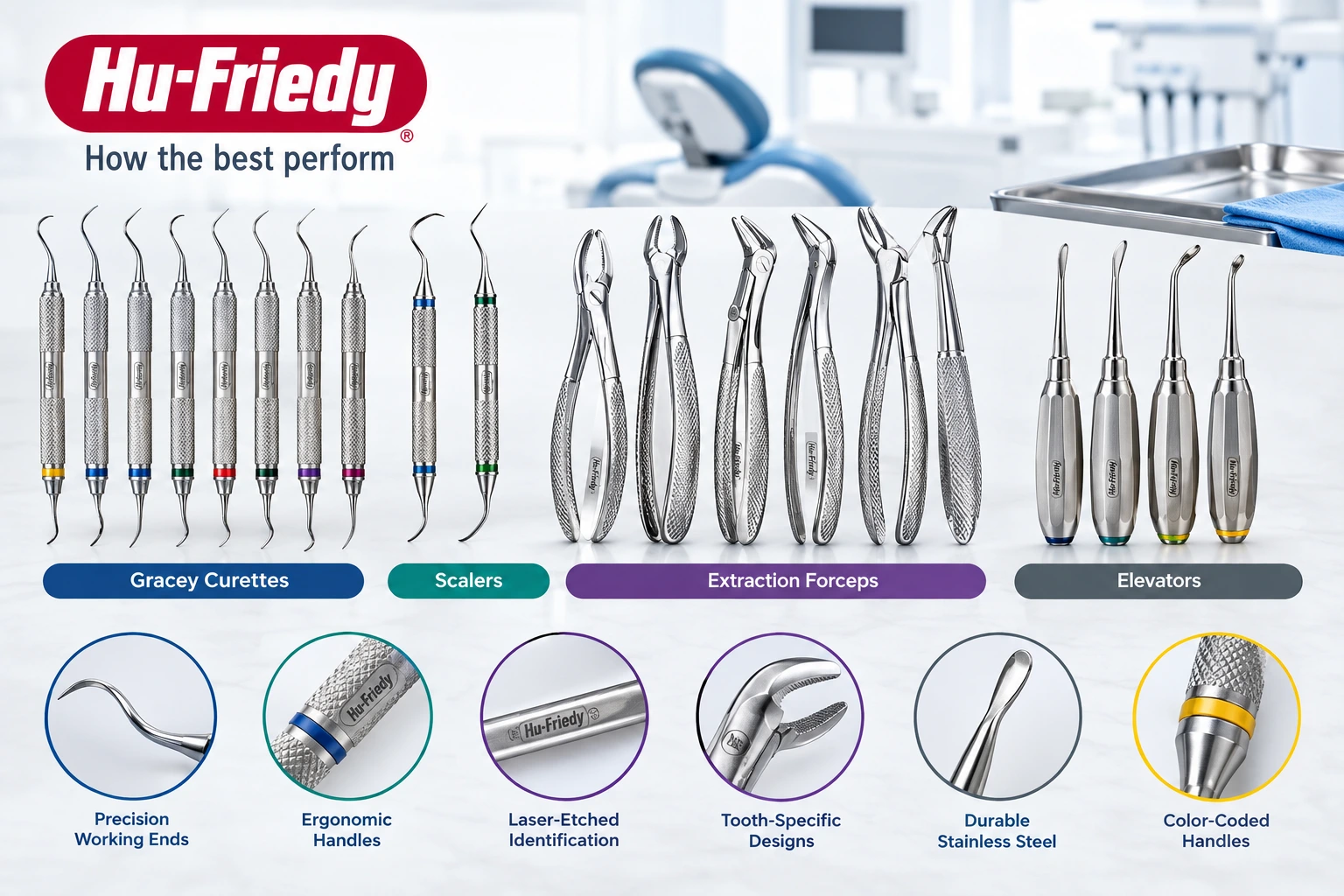
A practical buying guide to Hu-Friedy Gracey curettes, scalers, extraction forceps, and elevators — what each type is for, and how to spot genuine instruments in India.
If you've compared a genuine Hu-Friedy curette against a cheaper unbranded one side by side, the difference shows up fast — not in how it looks on day one, but in how it holds its edge after the fortieth scaling appointment. Hu-Friedy instruments India availability has grown steadily over the past few years, but the range is wide enough that most clinics end up guessing at what they actually need. This guide walks through the core categories — curettes, scalers, extraction forceps, and elevators — and what to actually look for when buying.
Why the Steel Matters More Than It Looks
Hu-Friedy instruments are made from a specific grade of stainless steel that's tempered to hold a cutting edge through repeated sterilization cycles — autoclaving is hard on cheaper steel, and an instrument that dulls after a dozen cycles ends up costing more in sharpening time than it saved at checkout. The other thing clinicians notice after switching is handle balance: a curette that's properly weighted reduces hand fatigue over a long scaling session, which matters more than it sounds on a day with back-to-back perio patients.
Hu-Friedy Gracey Curettes — Choosing the Right Set
Hu-Friedy Gracey curettes price varies quite a bit depending on whether you're buying individual curettes or a full set, and that's usually where first-time buyers overspend or underbuy. Gracey curettes are area-specific — the 1/2 and 3/4 are built for anteriors, the 7/8 and 9/10 for posterior facial and lingual surfaces, and the 11/12 and 13/14 for posterior mesial and distal surfaces respectively. Buying a full set (commonly sold as a 7-instrument or 9-instrument set) makes sense for a general practice doing regular periodontal maintenance; if your case mix leans heavily toward one arch or surface type, individual curettes let you avoid paying for instruments you'll rarely use.
The After Five and Mini Five variants are worth knowing about specifically: After Five curettes have a slightly longer terminal shank for deeper pocket access, and Mini Five curettes have a shorter, thinner blade for tighter or more delicate sites. Neither replaces the standard Gracey — they supplement it for specific pocket depths.
Hu-Friedy Scalers — Matching the Scaler to the Task
Hu-Friedy scalers online searches usually come from clinicians who already know they need a sickle scaler or a Jacquette but aren't sure which specific design fits their technique. Sickle scalers, with their pointed tip and triangular cross-section, are built for supragingival calculus removal and interproximal access on anterior teeth. Jacquette scalers offer a slightly different working-end angulation that many hygienists prefer for anterior and premolar surfaces. If you're stocking a hygiene operatory from scratch, a sickle scaler and a Jacquette scaler together cover most routine scaling needs before you add curettes for subgingival work.
Hu-Friedy Extraction Forceps — Getting the Right Design for the Tooth
Hu-Friedy extraction forceps India demand is usually driven by a specific gap in an oral surgery kit rather than a general restock, and that's the right way to think about forceps — they're tooth-and-arch specific by design, not interchangeable. Upper and lower forceps differ in beak angulation to match root anatomy, and molar forceps typically come in left and right pairs to account for root divergence. A general dental practice doing routine extractions usually needs, at minimum, a universal upper forceps, a lower universal, and a set of molar forceps for both arches; a practice doing more extensive oral surgery will want the fuller range including root tip and pediatric forceps.
Hu-Friedy Elevators — Straight, Angled, and Root Tip
Hu-Friedy elevators dental selection usually comes down to three broad categories: straight elevators for initial luxation, angled (or Cryer-pattern) elevators for proximal access once a tooth has started to mobilize, and root tip elevators for fragment retrieval. A common mistake in first-time kits is buying only straight elevators — they're the most familiar shape, but angled elevators are often what actually gets a tooth out once the straight elevator has done the initial loosening. If budget allows for only a small starter set, a straight elevator plus a pair of angled elevators (left and right) covers the bulk of routine extractions.
A Note on Buying Genuine Hu-Friedy in India
Hu-Friedy's reputation is exactly why counterfeit and re-stamped instruments occasionally circulate through unofficial channels — the brand name alone drives resale value even on poor-quality copies. A few checks worth doing before you order in bulk:
- Confirm the supplier sources through an authorised Hu-Friedy distributor, not a grey-market import
- Genuine Hu-Friedy instruments carry a laser-etched pattern number and, on most lines, a color-coded handle band — inconsistent or missing markings are a red flag
- If a bulk set is priced significantly below what individual pieces would cost from a known distributor, verify before committing
Frequently Asked Questions
How often should Hu-Friedy curettes be sharpened?
This depends on usage volume, but most clinics build sharpening into their regular instrument maintenance cycle rather than waiting for visible dulling — a curette that's lost its edge is far less effective at calculus removal even before it looks obviously worn.
Are Hu-Friedy scalers autoclavable?
Yes, Hu-Friedy instruments are designed to withstand standard autoclave sterilization cycles when manufacturer care instructions are followed.
What's the difference between a standard Gracey and an After Five curette?
The After Five has a terminal shank that's roughly 3mm longer, giving better access to deeper periodontal pockets without changing the working-end design.
Can the same forceps be used for both upper and lower extractions?
No — forceps beak angulation is designed to match the specific root anatomy and access angle of upper versus lower teeth, so they aren't interchangeable.
In Short
For a general dental practice, a solid Hu-Friedy starting kit covers a standard Gracey curette set, a sickle and Jacquette scaler, universal upper and lower forceps with a molar set, and a straight-plus-angled elevator combination. From there, expand based on your actual case mix rather than buying the full catalogue upfront.
Browse the complete Hu-Friedy range — curettes, scalers, forceps, and elevators — and check current stock and pricing on each product page.