
A practical guide to periodontal curettes and dental scalers in India: universal vs Gracey curettes, hand vs ultrasonic scalers, and what actually drives the price.
Open the instrument drawer in almost any general practice and you'll find the same pattern: a few well-worn favourites, and a few instruments nobody quite remembers buying. Scaling and root planing sets are where this happens most, because curettes and scalers look similar but behave very differently. If you're comparing periodontal curettes price across suppliers, it helps to understand what you're actually paying for before you compare numbers.
Curette or Scaler: Which One Does What
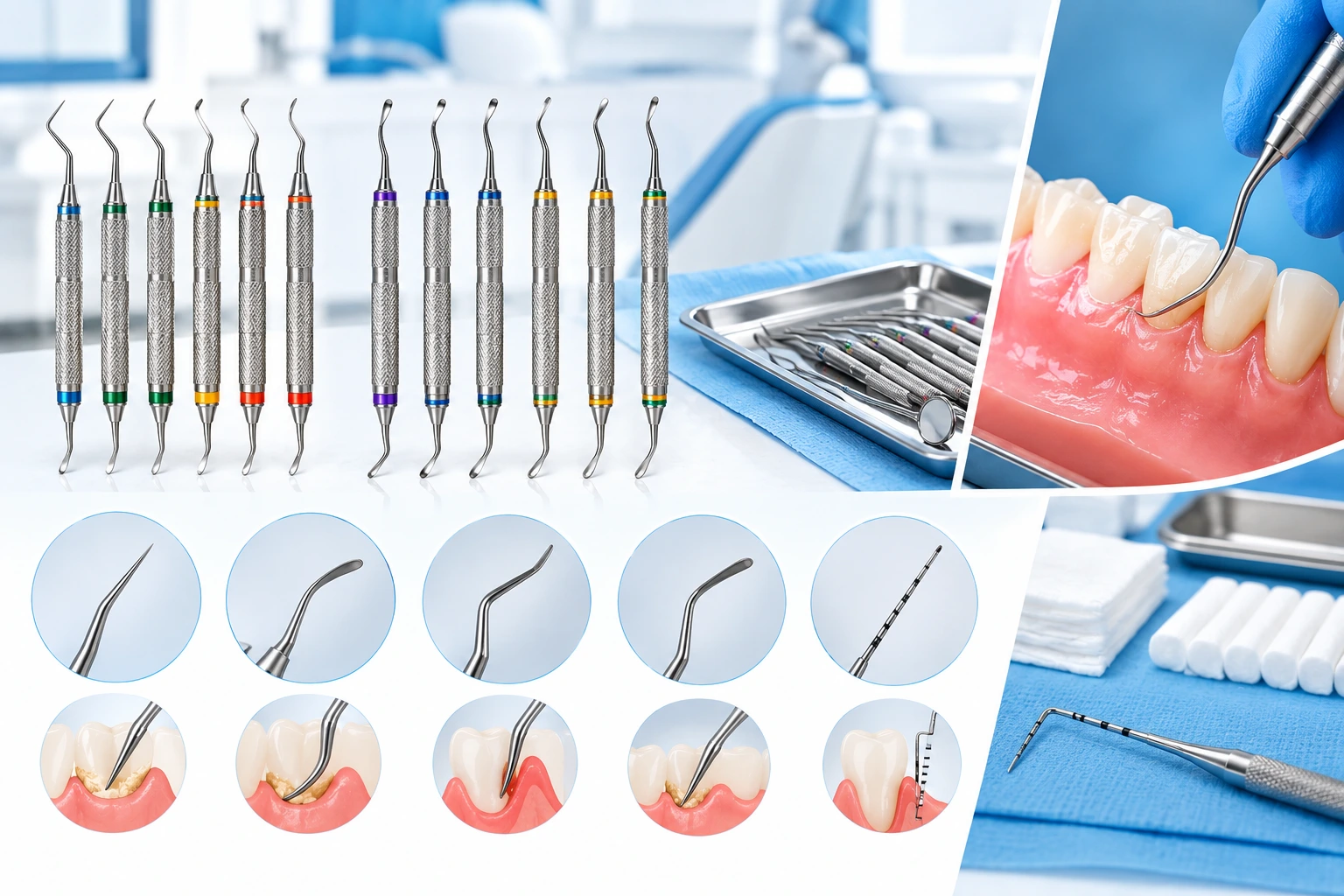
A scaler has a pointed tip and a triangular cross-section, which makes it effective for removing supragingival calculus, the deposits you can see above the gumline. A curette has a rounded toe and a spoon-shaped blade, so it can slide below the gumline for subgingival scaling and root planing without gouging the soft tissue. In practice, most hygiene sets use both: scalers first for the bulk of visible calculus, curettes next for the finer subgingival work.
Universal vs Gracey Curettes
Universal curettes have two cutting edges and a blade that sits at 90 degrees to the shank, which lets one instrument work on most tooth surfaces. That makes them a sensible starting point for a general practice that wants a compact set. Gracey curettes are area-specific: the blade is offset, only one edge cuts, and each number in the series is designed for particular surfaces. They adapt better in deep or awkward pockets, which is why periodontal specialists usually prefer them, but they take more knowledge to select and use correctly. If your case mix is mostly routine maintenance, universal curettes cover a lot of ground. If you regularly treat deeper pockets, adding Gracey curettes is worth it.
Hand Scalers vs Ultrasonic Scalers
When people search for dental scalers online, they are often really asking whether they still need hand scalers now that ultrasonic units are common. The honest answer is yes. Ultrasonic scalers are fast at breaking up heavy calculus and stain, and they reduce operator fatigue. But hand instruments give you tactile feedback to check that the root surface is actually smooth, and they reach spots where an ultrasonic tip is awkward to position. Most clinics get the best results from using both rather than choosing one.
What Actually Drives the Price
Two curettes that look nearly identical can differ a lot in price, and the difference usually comes from a few things:
- Steel quality: better steel holds its cutting edge through more sterilisation cycles, so you sharpen less often
- Handle design: lighter, textured or hollow handles reduce hand fatigue over a full day of scaling
- Blade finish and tolerance: poorly finished blades can feel rough or lose their edge quickly
- Single piece or set: sets are often better value if you need several patterns, but only if you will actually use all of them
A cheaper curette that needs sharpening twice as often can end up costing more in time and replacement than a better one, so it is worth thinking in cost per year of use rather than the sticker price alone.
Don't Forget the Probe
Scaling instruments work best alongside a good periodontal probe, since you need accurate pocket depth readings to decide which curette pattern to reach for. If you are building or restocking a perio set, check the range of periodontal probes at the same time so your charting and your scaling instruments match up.
Caring for Curettes and Scalers
Even good instruments underperform when they are neglected. Clean them promptly after use so debris does not dry on the blade, follow the manufacturer's sterilisation guidance, and sharpen on a regular schedule rather than waiting until the blade visibly drags. A sharp instrument needs lighter pressure, which is better for the patient and for your wrist.
Frequently Asked Questions
What is the difference between a curette and a scaler?
A scaler has a pointed tip and is mainly used to remove supragingival calculus, while a curette has a rounded toe and is designed for subgingival scaling and root planing without damaging soft tissue.
Should I buy universal curettes or Gracey curettes?
Universal curettes work on most surfaces and suit general practice, while Gracey curettes are area-specific and give better adaptation in deep or difficult pockets. Many periodontal practices keep both.
Why do periodontal curette prices vary so much?
Price depends mainly on the quality of the steel, how well the blade holds its edge through repeated sterilisation, handle design, and whether you are buying a single instrument or a set.
Can ultrasonic scalers replace hand scalers completely?
Not entirely. Ultrasonic scalers remove bulk calculus quickly, but hand instruments are still needed for fine finishing, root surface checking, and areas where ultrasonic tips cannot reach comfortably.
In Short
Start with a clear idea of your case mix. For routine maintenance, a few universal curettes and a couple of scalers cover most needs. For deeper periodontal work, add area-specific Gracey curettes. Judge price by how long the instrument holds its edge, not just what it costs on day one.
Browse the full range of periodontal curettes and dental scalers on DentalMart, and check current stock and pricing on each product page.
{ "@context": "https://schema.org", "@type": "BlogPosting", "headline": "Periodontal Curettes & Dental Scalers India: Types, Uses & Price Guide", "description": "A practical guide to periodontal curettes and dental scalers in India: universal vs Gracey curettes, hand vs ultrasonic scalers, and what actually drives the price.", "image": "https://dentalmart.in/images/blog/periodontal-curettes-scalers-guide.jpg", "author": { "@type": "Organization", "name": "DentalMart", "url": "https://dentalmart.in" }, "publisher": { "@type": "Organization", "name": "DentalMart", "logo": { "@type": "ImageObject", "url": "https://dentalmart.in/images/logo.png" } }, "datePublished": "2026-10-17", "dateModified": "2026-10-17", "mainEntityOfPage": { "@type": "WebPage", "@id": "https://dentalmart.in/blog/periodontal-curettes-dental-scalers-guide" } } { "@context": "https://schema.org", "@type": "FAQPage", "mainEntity": [ { "@type": "Question", "name": "What is the difference between a curette and a scaler?", "acceptedAnswer": { "@type": "Answer", "text": "A scaler has a pointed tip and is mainly used to remove supragingival calculus, while a curette has a rounded toe and is designed for subgingival scaling and root planing without damaging soft tissue." } }, { "@type": "Question", "name": "Should I buy universal curettes or Gracey curettes?", "acceptedAnswer": { "@type": "Answer", "text": "Universal curettes work on most surfaces and suit general practice, while Gracey curettes are area-specific and give better adaptation in deep or difficult pockets. Many periodontal practices keep both." } }, { "@type": "Question", "name": "Why do periodontal curette prices vary so much?", "acceptedAnswer": { "@type": "Answer", "text": "Price depends mainly on the quality of the steel, how well the blade holds its edge through repeated sterilisation, handle design, and whether you are buying a single instrument or a set." } }, { "@type": "Question", "name": "Can ultrasonic scalers replace hand scalers completely?", "acceptedAnswer": { "@type": "Answer", "text": "Not entirely. Ultrasonic scalers remove bulk calculus quickly, but hand instruments are still needed for fine finishing, root surface checking, and areas where ultrasonic tips cannot reach comfortably." } } ] }