
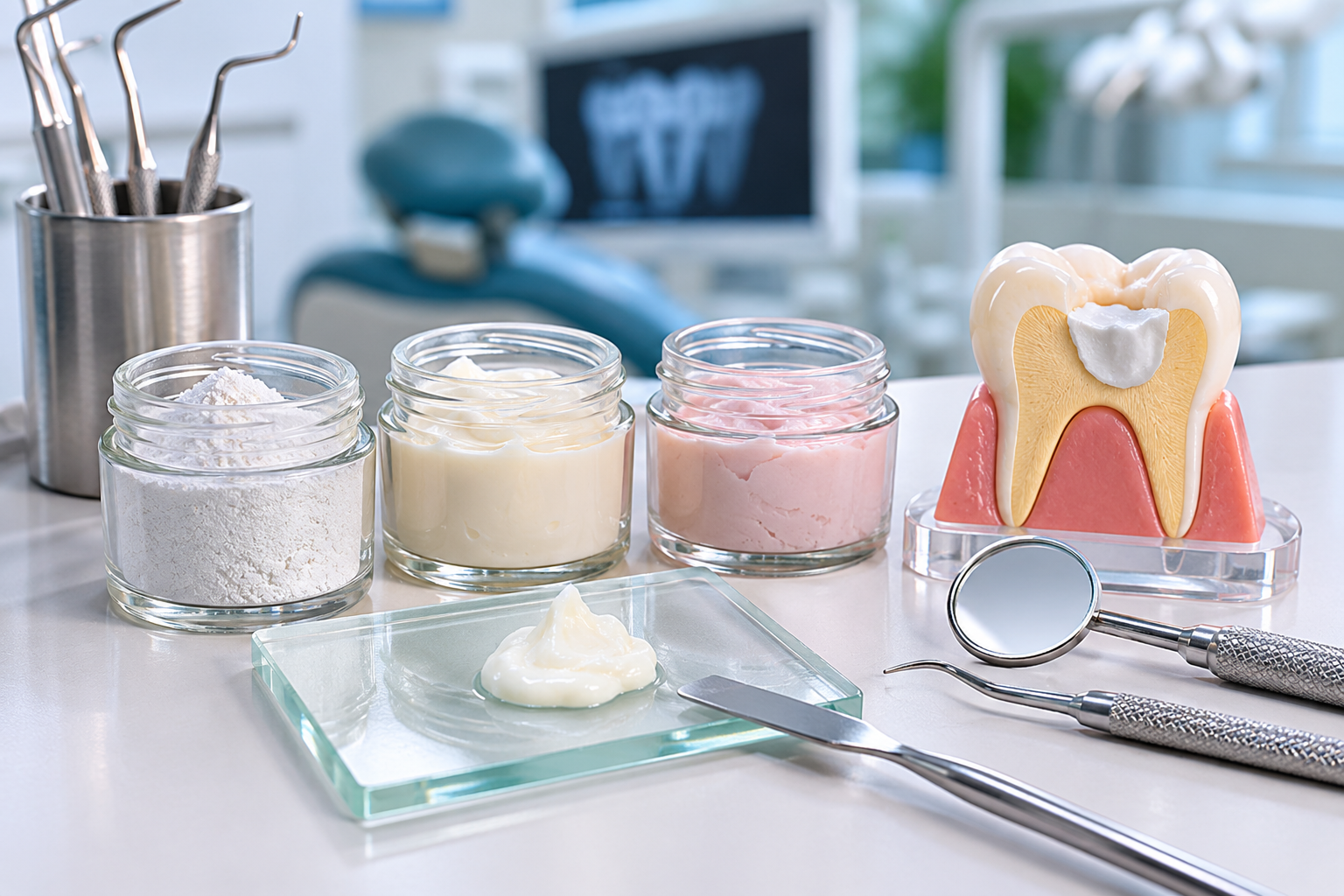
Discover the different types of temporary filling materials used in dentistry, their clinical applications, properties and limitations. Learn how zinc oxide eugenol, zinc sulphate and resin-based materials support provisional cavity restoration and endodontic treatment.
Temporary restorations are an important part of restorative and endodontic dentistry. During multi-visit treatments, dentists may need to protect a prepared cavity, seal an access opening or temporarily restore a tooth before placing its final restoration.
Temporary filling materials help protect the prepared tooth during this interval. They are selected according to the clinical situation, expected duration, cavity design, required sealing properties and the type of permanent restoration planned.
Different materials offer different handling characteristics, setting reactions, strength and sealing properties. Understanding these differences helps dental professionals select an appropriate material for each clinical application.
In this article, we explore the major types of temporary filling materials in dentistry, their uses, important properties and examples of products available through DentalMart.
What Is Temporary Filling Material?
Temporary filling material is a dental restorative material used to provide provisional protection and closure of a prepared tooth or cavity.
Unlike permanent restorative materials, temporary materials are generally designed for use over a limited period until the next stage of treatment or placement of a definitive restoration.
They may be used in situations such as:
- Between appointments during root canal treatment.
- After cavity preparation when permanent restoration is planned later.
- For temporary sealing of medicaments inside a tooth.
- During staged restorative procedures.
- For provisional protection of selected prepared cavities.
The material should provide an adequate seal, remain stable during the intended period and allow removal when the next treatment stage is performed.
The exact material depends on the clinical indication. A material suitable for temporary cavity closure may not be appropriate for temporary crown cementation or other provisional applications.
Why Are Temporary Filling Materials Used in Dentistry?
Temporary restorations serve several important purposes in dental treatment.
1. Protecting Prepared Cavities
After caries removal or cavity preparation, a tooth may require temporary closure before definitive restoration.
A suitable temporary material helps protect the prepared area from food debris, saliva and external contamination.
2. Sealing the Access Cavity During Root Canal Treatment
Root canal treatment may require more than one appointment.
Between visits, the access cavity needs to be sealed to reduce the risk of contamination of the root canal system.
An appropriate temporary restorative material helps maintain the seal until the next appointment.
3. Temporary Sealing of Medicaments
During endodontic treatment, intracanal medicaments may be placed inside the prepared root canal system.
A suitable temporary restoration is then used to close the access cavity and help retain the medicament between visits.
4. Protecting Teeth Before Permanent Restoration
Some restorative procedures involve multiple clinical stages.
Temporary filling materials can provide provisional protection while the dentist prepares for the definitive restoration.
5. Temporary Sealing of Inlay Preparations
Following tooth preparation for an indirect restoration, temporary material may be used to protect the prepared cavity until the final restoration is ready.
Types of Temporary Filling Materials Used in Dentistry
Temporary restorative materials are available in different formulations. Their composition and clinical behaviour influence their applications.
The following are some important material groups.
1. Zinc Oxide Eugenol (ZOE) Materials
Zinc oxide eugenol is a traditional dental material used in several provisional restorative and cementation applications.
It is formed by the reaction between zinc oxide and eugenol.
ZOE materials are available in powder-liquid and paste-based formulations, depending on the product.
Important characteristics:
- Established use in provisional dentistry.
- Generally convenient handling.
- Sedative properties are associated with eugenol.
- Can provide temporary sealing and provisional cementation.
- Mechanical strength and wear resistance may limit long-term use.
Clinical applications:
- Selected temporary cavity restorations.
- Temporary cementation of crowns and bridges.
- Provisional restorative procedures.
- Selected base and lining applications.
Important consideration: Eugenol may interfere with the polymerisation of some resin-based restorative and luting materials. When a resin-based definitive restoration is planned, the dentist should select an appropriate eugenol-free alternative when indicated.
2. Zinc Sulphate-Based Temporary Filling Materials
Zinc sulphate-based temporary materials are used for provisional cavity closure.
Some products are supplied as ready-to-use formulations, reducing the need for separate mixing.
Orafil-G by Prevest is an example of a zinc sulphate cement listed by DentalMart.
According to its product description, it is a ready-to-use material intended for provisional filling and temporary insertion of permanent crowns and bridges.
Product characteristics listed for Orafil-G:
- Ready-to-use zinc sulphate cement.
- Non-eugenol formulation.
- Resin addition for adhesive properties.
- Quick curing in a moist environment.
- Designed for provisional cavity restoration and temporary crown and bridge insertion.
Clinical applications listed:
- Temporary restoration of cavities between tooth preparation and permanent cementation.
- Temporary insertion of permanent crowns and bridges.
Product: Orafil-G 40gm Temporary Filling Material
3. Zinc Oxide and Calcium Sulphate-Based Materials
Some temporary filling materials use zinc oxide and calcium sulphate-based formulations.
These materials are commonly associated with pre-mixed temporary restorative products.
Their handling and setting behaviour make them suitable for selected short-term cavity-sealing applications.
Common characteristics may include:
- Ready-to-use presentation.
- Moisture-assisted setting.
- Easy placement and removal.
- Provisional sealing of prepared cavities.
The actual properties depend on the individual product formulation.
These materials should be used according to their instructions for use and the intended clinical indication.
4. Resin-Based Temporary Filling Materials
Resin-based temporary materials use polymer-based formulations to provide provisional restoration or cavity sealing.
Their composition and handling characteristics vary depending on the product.
Stic Temporary Cavity Filling Material, listed by DentalMart, contains a synthetic resin base and plaster filler.
According to its product description, it is a ready-to-use material with a two-stage setting mechanism.
Key features listed for Stic:
- Synthetic resin base with plaster filler.
- Ready-to-use presentation.
- Two-stage setting mechanism.
- Good marginal adaptation.
- Radiopaque formulation.
- Available in different consistencies and presentations.
Product indications listed:
- Temporary filling of cavities.
- Temporary sealing of inlay preparations.
- Temporary sealing of medicaments.
- Temporary fixing of post crowns.
Product: Stic Temporary Cavity Filling Material 30gm
Common Clinical Applications of Temporary Filling Materials
The appropriate material depends on the procedure and the expected duration of provisional restoration.
1. Temporary Restorations Between Appointments
When a tooth requires multiple treatment visits, a temporary restoration can protect the prepared cavity until the next appointment.
The material should provide an adequate seal and remain sufficiently stable during the intended interval.
2. Endodontic Access Cavity Closure
Temporary materials are frequently used to close the access cavity between root canal appointments.
A good coronal seal is important because leakage may allow microorganisms and oral fluids to enter the prepared root canal system.
The material should be selected according to the cavity dimensions, available restorative space and expected time before the next appointment.
3. Temporary Sealing of Inlay Preparations
Prepared inlay cavities may require temporary coverage before the definitive restoration is fitted.
The provisional material helps protect the preparation during this period.
4. Temporary Cementation
Certain temporary materials are designed for provisional insertion of crowns and bridges.
However, temporary luting cements and temporary cavity filling materials have different purposes.
A product intended for cavity filling should not automatically be used for cementation unless the manufacturer specifically indicates that application.
5. Temporary Post-Crown Procedures
Some temporary restorative products are indicated for provisional sealing or fixing of post crowns.
Always check the product's official indications before selecting it for a particular procedure.
Cavitemp: Ready-Mix Temporary Filling Paste
Cavitemp is a ready-mix temporary filling paste listed by DentalMart under the AMMDENT brand.
According to its product listing, it is a 30gm temporary filling paste that sets in contact with saliva.
Product details:
- Ready-mix temporary filling paste.
- Sets in contact with saliva.
- Supplied in a 30gm presentation.
- Intended for temporary filling applications.
Its ready-to-use presentation may be convenient for clinicians who prefer a pre-mixed temporary restorative material.
Product: Cavitemp Temporary Filling Material
The exact clinical selection and application should follow the manufacturer's product instructions.
Temporary Filling Material vs Permanent Filling Material
Temporary and permanent restorative materials have different intended purposes.
| FeatureTemporary Filling MaterialPermanent Filling Material | ||
| Main purpose | Provisional protection and sealing | Definitive restoration |
| Intended duration | Limited period | Long-term restoration |
| Mechanical requirements | Suitable for temporary function | Designed for longer-term function |
| Removal | Generally designed to be removed or replaced | Intended to remain as the definitive restoration |
| Examples | Temporary restorative pastes and cements | Composite, glass ionomer and other definitive restorative materials |
The selection of a definitive restorative material depends on the tooth, cavity size, location, occlusal forces and clinical requirements.
Temporary filling materials should not be treated as substitutes for definitive restoration.
What Makes an Ideal Temporary Filling Material?
An appropriate temporary restorative material should offer a combination of useful properties.
1. Adequate Sealing Ability
One of the most important requirements is the ability to seal the prepared cavity and help reduce bacterial and fluid penetration.
This is especially important during multi-visit endodontic treatment.
2. Suitable Mechanical Strength
The material should withstand the expected forces during the intended provisional period without excessive breakdown.
3. Dimensional Stability
A temporary restoration should maintain its shape and marginal adaptation during the intended period.
4. Easy Handling
Materials that are easy to dispense, place and adapt can support an efficient clinical workflow.
5. Controlled Setting Behaviour
The setting characteristics should be suitable for the clinical procedure and the manufacturer's recommended technique.
6. Easy Removal
Temporary restorations generally need to be removed when the next stage of treatment begins.
The material should allow removal without unnecessary damage to the remaining tooth structure.
7. Compatibility With Subsequent Treatment
The dentist should consider the next restorative or cementation procedure.
For example, eugenol-containing materials may interfere with some resin-based procedures, making material selection particularly important.
Factors That Can Affect the Performance of Temporary Restorations
Even an appropriate material may not perform as expected if the cavity preparation, placement technique or clinical conditions are unsuitable.
Some important factors include:
- Remaining cavity wall thickness.
- Cavity design and retention.
- Thickness of the temporary material.
- Moisture contamination during placement.
- Occlusal loading.
- Material selection.
- Duration before definitive restoration.
- Correct handling and setting procedure.
Research on temporary restorations in endodontics highlights the importance of material selection, adequate thickness and maintaining an effective coronal seal.
The dentist should follow the manufacturer's instructions and assess the temporary restoration during subsequent visits.
Temporary Filling Materials Available on DentalMart
DentalMart lists several temporary restorative materials from different manufacturers.
The following products can be explored according to their listed descriptions and clinical indications.
1. Orafil-G 40gm – Prevest
A ready-to-use zinc sulphate cement listed for provisional cavity filling and temporary insertion of crowns and bridges.
2. Stic Temporary Cavity Filling Material – 30gm
A ready-to-use material containing a synthetic resin base and plaster filler.
3. Cavitemp Temporary Filling Material
A ready-mix temporary filling paste that sets in contact with saliva.
You can also explore the complete Temporary Filling Material category to see other available products.
Prices and stock can change, so check the current product pages before ordering.
Frequently Asked Questions About Temporary Filling Materials
1. What is temporary filling material used for?
Temporary filling material is used to provide provisional closure and protection of prepared cavities. It may be used between dental appointments, during root canal treatment and before placement of a definitive restoration.
2. What are the different types of temporary filling materials?
Common material groups include zinc oxide eugenol materials, zinc sulphate-based materials, zinc oxide and calcium sulphate-based materials, and resin-based temporary restorative materials. Their properties and indications vary by formulation.
3. What is the difference between temporary and permanent filling materials?
Temporary filling materials are designed for provisional protection over a limited period, whereas permanent restorative materials are intended for definitive restoration and longer-term function.
4. Why are temporary filling materials used during root canal treatment?
They are used to close the access cavity between appointments and help reduce contamination of the prepared root canal system.
5. What is Orafil-G used for?
According to its DentalMart product description, Orafil-G is a ready-to-use zinc sulphate cement indicated for provisional cavity filling and temporary insertion of permanent crowns and bridges.
6. What is Cavitemp temporary filling material?
Cavitemp is a ready-mix temporary filling paste listed by DentalMart. Its product description states that it sets in contact with saliva and is supplied in a 30gm presentation.
7. What is Stic temporary cavity filling material?
Stic is a ready-to-use temporary restorative material containing a synthetic resin base and plaster filler. Its listed indications include temporary cavity filling, sealing of inlay preparations and temporary sealing of medicaments.
8. Can temporary filling material be used as a permanent filling?
Generally, no. Temporary filling materials are designed for provisional use and should be replaced or followed by definitive treatment as clinically indicated.
9. Can eugenol-based materials be used before composite restoration?
Eugenol may interfere with the polymerisation of some resin-based materials. The dentist should consider the planned definitive restoration and select a compatible temporary material.
10. Where can I buy temporary filling materials in India?
Dental professionals can explore temporary filling materials such as Orafil-G, Stic and Cavitemp through DentalMart. Check individual product listings for specifications, current pricing and availability.
Final Thoughts
Temporary filling materials play an important role in restorative and endodontic dentistry. They provide provisional protection, support cavity closure and help maintain the seal between treatment appointments.
Different formulations offer different handling characteristics, setting behaviour and clinical applications. Zinc oxide eugenol, zinc sulphate-based and resin-based products are among the materials used for provisional restorative procedures.
Understanding the material composition, clinical indication and limitations helps dental professionals select an appropriate product for each case.
Explore the available Temporary Filling Materials on DentalMart to find products for your dental practice requirements.
DentalMart – Dental Instruments, Materials and Supplies Online in India.